Be yourself; Everyone else is already taken.
— Oscar Wilde.
This is the first post on my new blog. I’m just getting this new blog going, so stay tuned for more. Subscribe below to get notified when I post new updates.
Be yourself; Everyone else is already taken.
— Oscar Wilde.
This is the first post on my new blog. I’m just getting this new blog going, so stay tuned for more. Subscribe below to get notified when I post new updates.
This is an example post, originally published as part of Blogging University. Enroll in one of our ten programs, and start your blog right.
You’re going to publish a post today. Don’t worry about how your blog looks. Don’t worry if you haven’t given it a name yet, or you’re feeling overwhelmed. Just click the “New Post” button, and tell us why you’re here.
Why do this?
The post can be short or long, a personal intro to your life or a bloggy mission statement, a manifesto for the future or a simple outline of your the types of things you hope to publish.
To help you get started, here are a few questions:
You’re not locked into any of this; one of the wonderful things about blogs is how they constantly evolve as we learn, grow, and interact with one another — but it’s good to know where and why you started, and articulating your goals may just give you a few other post ideas.
Can’t think how to get started? Just write the first thing that pops into your head. Anne Lamott, author of a book on writing we love, says that you need to give yourself permission to write a “crappy first draft”. Anne makes a great point — just start writing, and worry about editing it later.
When you’re ready to publish, give your post three to five tags that describe your blog’s focus — writing, photography, fiction, parenting, food, cars, movies, sports, whatever. These tags will help others who care about your topics find you in the Reader. Make sure one of the tags is “zerotohero,” so other new bloggers can find you, too.
There are a variety of wheelchair accessories out there and each one fulfills a different purpose. In fact, they can be a traveler’s best friend. If you are traveling with your power wheelchair, you’ll want to check out our list of accessories that will be useful for your upcoming trip.
Accessories for Storage
It’s always good to be prepared when going away. Whether you are looking for empty space to carry souvenirs or for your everyday necessities, we have a couple different options that you can look into. If you’re looking for storage space for smaller items, we recommend our glove box. Although its primary function is in its name, you can get creative and fit various small items in there, such as keys and sunglasses. Since we offer the glove box, they are compatible with our Quantum motorized wheelchairs, so you don’t have to worry about carrying the glove box with you. You can easily attach it to your power wheelchair and go.
For bigger items, such as a map, towel and snacks, we suggest carrying our Quantum backpack. Now, you could look online for any ordinary backpack that you like. However, the Quantum backpack was specially designed for power wheelchair users, featuring smaller straps that won’t get in the way while you sightsee and navigate around your destination. In addition to the smaller straps, it features a clip that will help secure the backpack to your Quantum motorized wheelchair so that it doesn’t slip off.
We also offer a pair of backpack holders that will make your life easier as you travel without having to carry a lot.
Accessories for Visibility
Traveling during the daytime is the safer choice when it comes to visibility. If you will mostly be out and about during the day, you can have visibility both behind and ahead with our rearview mirror.
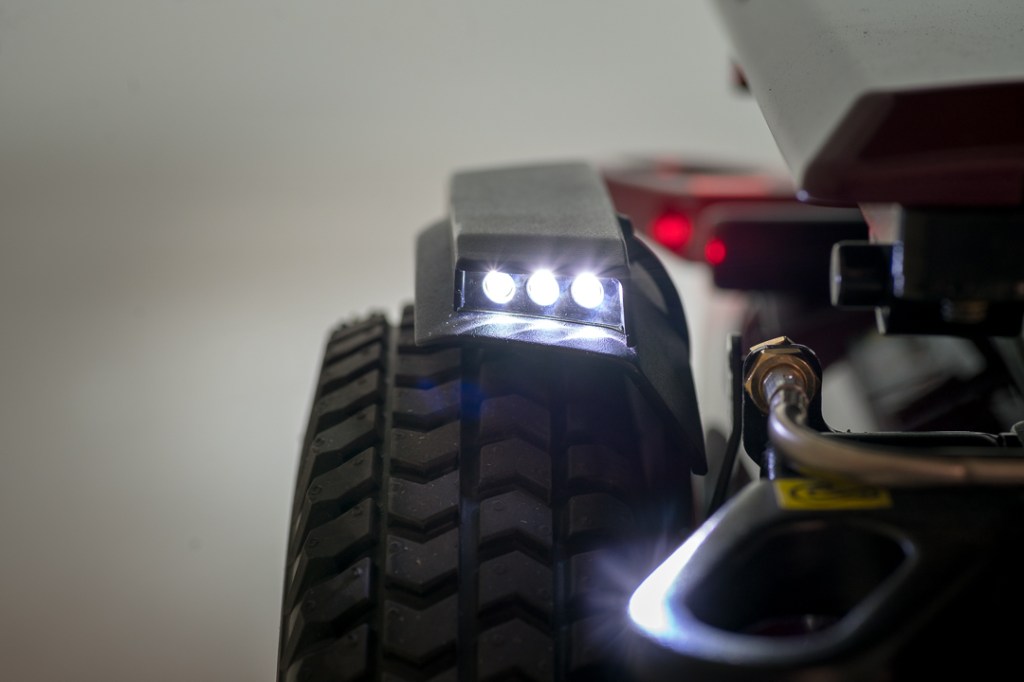
However, it’s not uncommon to find good deals on overnight plane rides and bus trips. Whether you need to cross the street to get to the station or navigate in the dark, we offer a few options that will help you both see where you’re going and be seen by others. LED fender lights come standard on the Edge® 3, iLevel®, 4Front® and Q6 Edge® Z. If you have a power wheelchair that doesn’t come with LED fender lights, another great option for visibility is the reflector kit.
Accessories for Staying Hydrated
Not only is your visibility and safety important, but so is your health. Keep hydrated while on the go with our front-mounted cup holder that attaches to our power wheelchairs, allowing you to carry your beverage with you wherever you go.
An alternative option we have for power wheelchairs is the hydration system. You can enjoy your drink through a long bendy straw that wraps around your chair towards the front, with a bottle mounted to the back of the motorized wheelchair.
Accessories for Your Phone
The last thing you want while you’re away from home in an unfamiliar place is your primary source of communication, and in some cases navigation, dying. Our standard USB charger powers electronic devices, like your phone, while on the go. It comes standard on the Edge 3 power wheelchair.
We also offer the TRU-Balance® 3 USB mobile device charger, which is different than the standard USB charger. The TRU-Balance 3 version is available as an option on all TRU-Balance 3 seating systems.
If you are interested in purchasing an accessory for your motorized wheelchair, you can reach out to a local Quantum Rehab® provider. If you aren’t sure who your authorized Quantum provider is, call us at 1-833-745-3835 with the motorized wheelchair’s serial number and we’ll be happy to point you in the right direction. If you aren’t sure where to find the serial number, you can check out our FAQ page to learn more.
Check out our article to learn more about what accessories for power wheelchairs we offer!
The word accessory may make you think of an item that is added for aesthetics. However, accessories are not just something pretty that you can get with your motorized wheelchair. The truth is, our accessories are also functional, meaning that they serve a purpose beyond making your power wheelchair look cool, enhancing your ride experience as you go through day-to-day life. Although any of our accessories would make great gifts for you or your loved ones, everyone is different in both personality and lifestyle. For this reason, we offer a wide range of accessories to meet the needs of a variety of wheelchair users. The best kinds of gifts are personal and meaningful. What’s more meaningful than helping to personalize the power wheelchair of a loved one by gifting them an accessory that’s perfect for them?
Accessories for Storage
If they are frequently on the go or enjoy exploring new places, we recommend our accessories for storage, including a glove box for smaller items and a Quantum backpack for bigger items. Why carry should they carry their baggage when their chair can do it for them? For those who use the Quantum backpack, a purse, or shopping bag, we suggest checking out the personal item hook and backpack hook.
Accessories for Hydration
When traveling, it’s important to remember some of the things we do that may get overlooked when we are away from home, such as staying hydrated. With our front-mounted cup holder that attaches to our power wheelchairs, your loved ones can carry their beverage of choice all day with them.
Another option we have for power wheelchairs is the hydration system. They can now enjoy their favorite beverage through a long bendy straw that wraps around the chair towards the front, with a bottle mounted to the back of their motorized wheelchair.
Accessories for Safety
You and your loved one’s safety is important to us. We offer a few accessories that can enhance the safety of wheelchair users. Transfer bars on sides of chair provide additional support in assisting wheelchair users in transferring into and out of their power wheelchair.
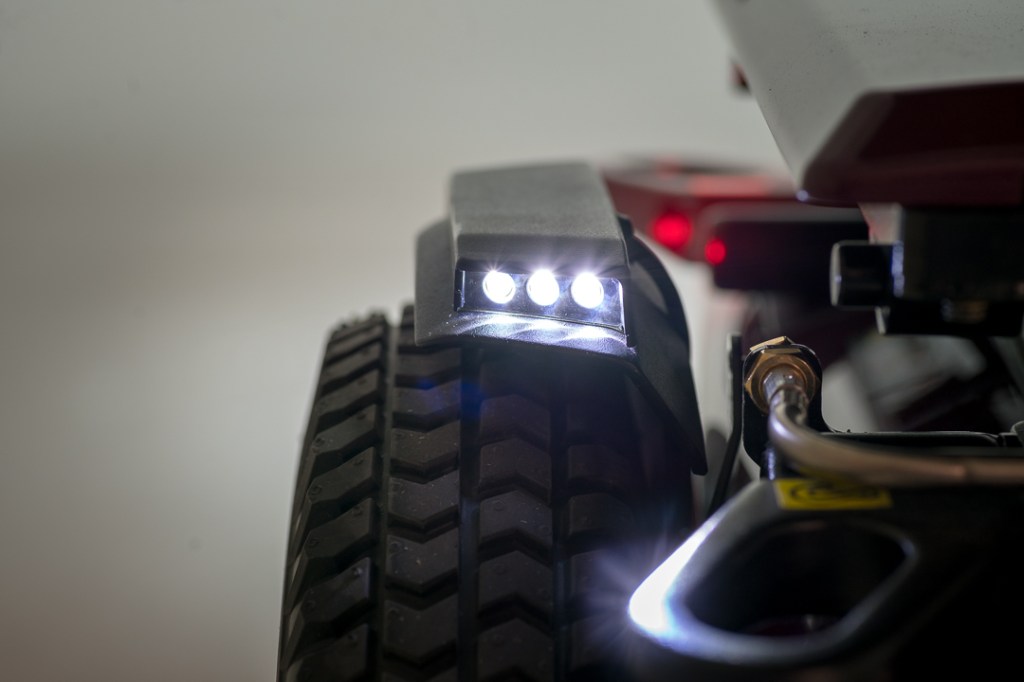
When it comes to being on the go, it’s important to see and be seen. LED fender lights come standard on the Edge 3, iLevel®, 4Front® and Q6 Edge® Z. For power wheelchairs that don’t come with LED fender lights, another great option for visibility is the reflector kit. It’s as important that you and your loved ones can see others. With the rearview mirror, you can have visibility both behind and ahead.
Accessories for Technology
Accessories are a techie’s best friend! The tablet holder and phone holder make great assistants in holding your electronic devices and pair well with the USB mobile device charger to keep them charged.
It is important to know that these not all these accessories are available with every product. Some are only available on TRU-Balance® 3 and TRU-Balance® 3 HD seating systems. Whether you are interested in treating yourself or purchasing an accessory or two for your loved one’s motorized wheelchair, you can reach out to a local Quantum Rehab provider. If you aren’t sure who your authorized Quantum provider is, we are happy to help point you in the right direction! Just give us a call at 1-833-745-3835 with the power wheelchair’s serial number. If you aren’t sure where to find the serial number, you can check out our FAQ page to learn more.
You may have heard of wheelchair tennis and para-badminton, but have you heard of para-pickleball? Though it’s not currently as widespread as other paddle or racket sports, you may just want to add this to your list of adaptive sports to try.
Pickleball is considered a paddleball sport that encompasses some of the aspects of tennis, badminton and table tennis or ping-pong. This sport is played by two or four players who use solid paddles made of wood. The basic idea is to hit a ball, like a wiffle ball, over a net.
Pickleball was invented in the mid-1960s on Bainbridge Island, not far from Seattle, Washington. According to the USA Pickleball Association (USAPA), three fathers, Joel Pritchard, Bill Bell and Barney McCallum are credited for creating pickleball as a backyard game for family, as a remedy for their kids who were bored with their usual summertime activities. Pickleball was later adapted for wheelchair users and is known as para-pickleball.
Contrary to its name, pickleball has nothing to do with pickles. There are multiple accounts of the origin of the name of this sport, but no one knows the true origin of the name. Two popular theories, according to the USAPA are that Joel Pritchard’s wife said that she started calling the game pickleball because the combination of different sports reminded her of the pickle boat in crew where oarsmen were chosen from the leftovers of other boats. Another theory they mention is that the game was officially named after the Pritchards’ dog Pickles, who would chase the ball and run off with it.
Pickleball shares elements of other racquet sports, but also has its differences, which make it unique. For instance, it is played on a 20’ x 44’ court, sharing the dimensions of a badminton court. Like tennis, players in wheelchairs can play single or doubles matches. Teams can be made up of a wheelchair player partnered with a standing player, making para-pickleball different from other adaptive sports. The ball is served diagonally, and points can only be scored by the side that serves. The serve must clear the seven-foot non-volley-zone in front of the net and land in the diagonal service court. The first side scoring eleven points and leading by at least two points wins.
The official International Federation of Pickleball rules already includes a section on wheelchair rules, which, as you can guess, only apply to wheelchair users. The wheelchair is considered part of the player’s body and all applicable rules that apply to a player’s body will apply to the wheelchair, with some exceptions. A few modifications have been made, including that a double bounce is allowed for the para-athlete and the front wheels of his or her chair can cross the non-volley line. For more details on para-pickleball rules, you can check out the USAPA/IFP Pickleball rules on their website.
Although pickleball is growing and played in all 50 states, it may be difficult to find para-pickleball teams to play with for fun. There’s always the option of starting your own team.
One thing you can do is contact a para-sport organization in your area to find out where to find potential candidates to play para-pickleball. You can also pitch the idea of para-pickleball to the local sports and para-sports organizations. Be sure to mention its versatility and inclusivity, as teams can be made up of a wheelchair user partnered with a standing player or play doubles against a team of two able-bodied individuals.
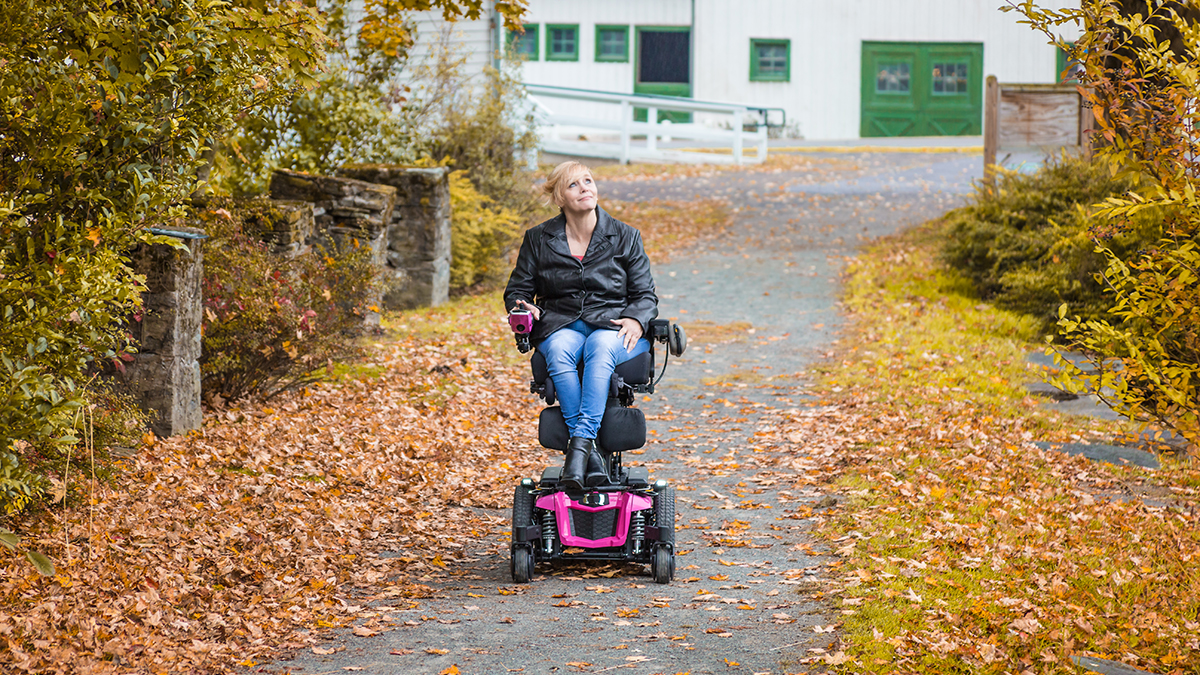
You’re an outdoor enthusiast and want to enjoy nature. You’ve added some accessible national parks and trails to your list and have started planning your trip. Now, onto the next hurdle.
One of the worst parts of going on a trip is packing. No matter how many times you’ve gone on trips, it’s so easy to forget that one important item that you hadn’t thought to bring. Even coming up with a list of items on the spot can be a challenge. One thing you will bring on your camping trip is your motorized wheelchair.
Your motorized wheelchair isn’t meant to be extra baggage for your trip. In fact, there are several features that are beneficial for traveling. The best part is that these features are all a part of your power wheelchair. You don’t have to remember to pack anything extra.
iLevel®
You may already be familiar with the benefits of iLevel® Power Adjustable Seat Height and how it can not only assist you in doing daily tasks independently, but provide new opportunities to have conversations at eye level with your friends and family. You can also take your camping trip to a whole new level. The difference between a nice view and a spectacular view may be giving yourself 12” of added height.
Even though efforts are being made to making campgrounds more accessible for wheelchair users, there is still a long way to go. If you are going camping but are not staying in a wheelchair-accessible cabin, iLevel can assist with transferring from surfaces such as beds and toilets that are higher than the seat on your motorized wheelchair when it is not elevated. It can also help you to reach high enough to access dresser drawers, light switches and the bathroom sink that were not originally built with accessibility in mind.
SRS
Life can be a bumpy ride, but your camping trip doesn’t have to be. Although you can’t completely avoid the gravel and uneven terrain that makes up much of nature, having reliable suspension on your motorized wheelchair can help prevent user fatigue and discomfort due to high amounts of vibration from going over rough terrain in your power wheelchair. With unprecedented comfort and ride quality, Smooth Ride Suspension (SRS) delivers exceptional driving performance over multiple types of terrains. SRS also adds stability to optional iLevel, making it the perfect built-in companion.
LED lights
Visibility is a part of accessibility that tends to get overlooked. It can be frustrating to go outside and not know what to expect because of the darkness. Once the fire has died down and your loved ones have gone to bed, you want to navigate around the campsite safely without accidentally waking anyone.
Maneuver around your cabin or the campground safely and hands free with LED fender lights. LED lights come standard both on the Edge 3 and iLevel and offer great benefits and features for increased visibility. With lighting mounted to the fender above the drive tire on each side of the power wheelchair, fender lights help ensure that you can see and be seen. Whether it’s finding the bathroom across the campsite or coming back from an event on your own, find your way back without the hassle of carrying a flashlight with you.
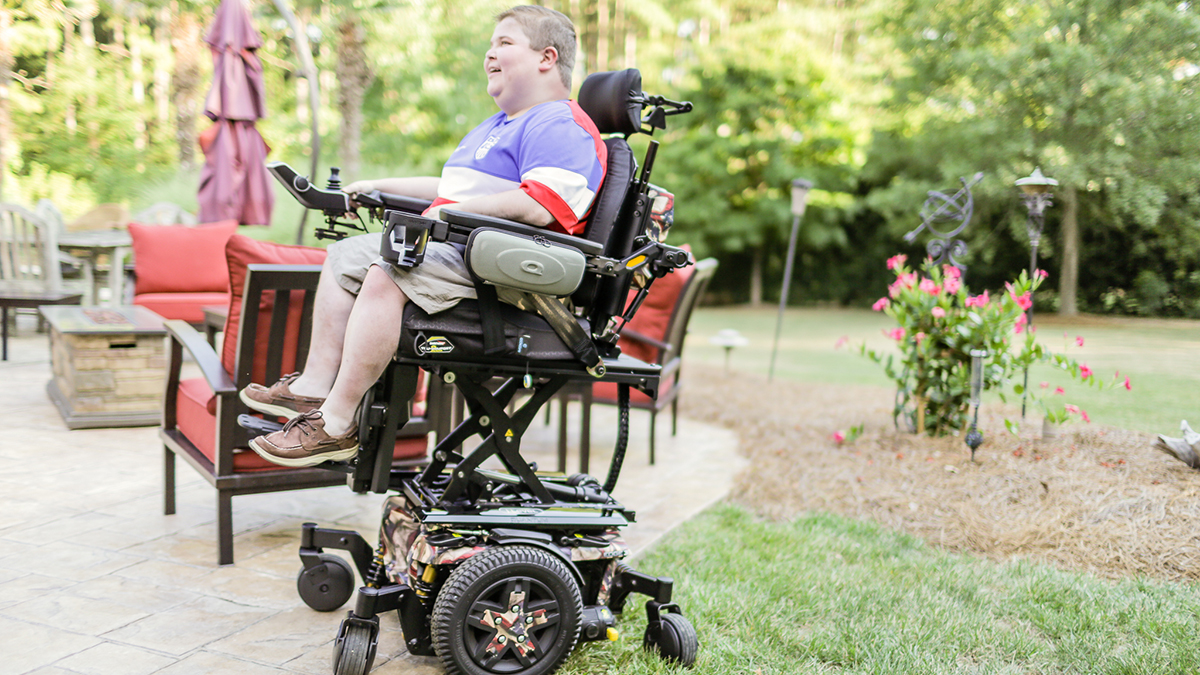
You may have seen the term “staycation” floating around the internet in recent years. Although the concept of staying at home isn’t new, staycations have taken the online world by storm.
You can probably guess by the name that a staycation is the act of taking time off from work or daily activities to explore one’s hometown or city. Staycations are like any other vacation, except that they happen right in your own area. They still require a little bit of planning and the willpower to not fall into the trap of continuing your daily routine, being that you are in the same environment.
There are several benefits to foregoing time away from home to stay right where you are. Staying home doesn’t mean staying in your house not doing anything, unless of course, that is your ideal way to relax. We’ve compiled a list of five reasons why you may want to plan a staycation.
While you won’t have zero expenses, you will have significantly less expenses than if you were traveling out of town. You will still need to eat and find a way to get around, but you won’t need to worry about additional travel expenses, such as plane or bus tickets and hotels. Some people opt to stay in hotels or resorts in their area just for a change of environment, but how you plan your staycation and how much you spend on restaurants, activities and possible lodging is up to you.
Just as you can subtract some travel expenses from your list, you can also subtract potential travel and time stressors that could come up if you’re traveling away. This includes running to catch a plane and get through TSA in time and worrying that you’ll forget something when packing.
Staycations also take the stress out of planning. If you’ve been in your area for a while, you’ll know what’s accessible without having to do a lot of research.
Staycations are meant to be relaxing. I was once talking to someone who told me that there’s a difference between going on a vacation or a trip. I always thought the two concepts were synonymous, but he had a point. Sometimes taking a vacation requires traveling, but is a vacation really a vacation if you aren’t relaxing? If you are trying to clear a list of places you want to go or things you want to see in a short amount of time, isn’t it more like a trip than a vacation? If you’re staycationing, your time away from work and other activities can be more relaxing than if you were to go away.
Even though you are dedicating a set amount of time to your staycation, you don’t have to feel the pressure of doing everything that you want or hope to in that amount of time. Since you are exploring the area in which you live, you can take your time doing everything that you’d like to do. Why? Those places will still be there, even after you go back to work or resume your daily schedule. This allows you to enjoy what’s around you at your own pace.
Unlike planning a trip with friends and family somewhere else, it’s so much easier to plan a staycation with the ones you love. Staying in your area means you have a higher chance of your loved ones joining you in your activities, providing it works with their schedule. It’s much more difficult to plan a trip with multiple people when it comes to being away, especially if their travel style is different from yours and you can’t agree on a budget.
Now that you know the benefits of planning a staycation, perhaps you find yourself wanting to plan one, but have no idea where to start. Check out our article on planning a staycation to learn more!
Your child’s Edge 3 Stretto™ is a sophisticated power chair. Like any mobility product, it requires routine maintenance checks, some of which require assistance from your Quantum Rehab Provider. Preventive maintenance is very important. Getting your child’s power wheelchair serviced can help ensure that the power wheelchair gives him or her years of trouble-free operation. Getting your child’s wheelchair serviced can be done in a variety of ways.
The first thing we recommend you do if your child’s wheelchair needs servicing is to contact your dealer. If you aren’t sure who your local dealer is, contact us with your child’s power wheelchair’s serial number and we can look up who your authorized Quantum Rehab® dealer is and give you their contact information. They can assist in servicing your child’s wheelchair, as well as getting any necessary wheelchair parts.
Does your dealer use Interactive Assist? If you have the Q-Logic 3 controller, your provider can use Interactive Assist to eliminate wasteful trips! This must-have app for remote service provides a direct, real-time connection from a power chair’s electronics to a provider’s programming station. The connection provides the technician with full system and diagnostics information along with tools, such as a real-time mirror image of the power chair’s electronics display. Using Interactive Assist, your provider may be able to quickly resolve issues with your chair. If you don’t currently have the app, you can download it today from your phone’s app store.
If you are away from home and need to get your child’s wheelchair serviced, you can easily locate an authorized Quantum dealer near you. The process is simple:
The search results of providers include the provider name and contact information. If you are unfamiliar with the address, you can also view directions and a map for added convenience. After finding the provider’s information, you can choose to contact the provider yourself, or request to be contacted. Just click the “Request to be Contacted” button on the right and fill out the form. The provider will then contact you directly.
Quantum Rehab has subsidiaries around the world that work with local dealers in other countries. If your child’s wheelchair needs servicing while outside of the United States, contact us or one of our international subsidiaries. we can have a dealer from that region contact you.
You can reach us by phone at 1-833-745-3835, on our Facebook page, live chat on our website or by filling out a contact form.
To contact one of our international subsidiaries, locate the international dropdown menu at the top of our website and click on the corresponding subsidiary, closest to where you’re located. The subsidiary lists contact information, such as email addresses and phone numbers on their page. If applicable, you may also contact them through their social media pages.
Even if you follow the best charging practices to prolong the life of your child’s wheelchair batteries, there may come a time when you have to replace them. When you are ready to replace and dispose of them, you may wonder if the batteries for your child’s electric wheelchair are covered by Medicare.
When durable medical equipment (DME) is deemed medically necessary for the pediatric wheelchair user, Medicare Part B may cover a portion of the cost of a wheelchair. Medicare requires a face-to-face examination with your child’s healthcare provider prior to writing a prescription for a power mobility device. During your child’s exam, his or her physician must first consider the use of other mobility devices, such as a cane, walker, manual wheelchair or scooter before considering a complex power rehab motorized wheelchair.
If their physician feels that your child’s mobility needs must be resolved with a motorized wheelchair, this needs to be documented in his or her medical records. If their physician requests further examination to help determine the necessity of a motorized wheelchair, they may set up an appointment with a physical therapist or occupational therapist to conduct further assessment.
If your child’s pediatric power wheelchair is prescribed by a doctor, it is considered medically necessary. Pediatric complex rehab wheelchairs are generally needed by children who have significant physical or mobility disabilities due to birth disorders, neuromuscular diseases and injuries.
In addition to your child’s power wheelchair, Medicare Part B can also cover replacement batteries for their power chair if his or her current pediatric wheelchair batteries are no longer working properly. In short, if you qualify for the motorized wheelchair, you also qualify for replacement batteries. You can visit Medicare.gov or call 1-800-MEDICARE (1-800-633-4227) for further details or to ask them any questions regarding coverage under Part B.
Before buying the batteries for your child’s wheelchair, it is important to verify that the provider you have chosen to work with accepts Medicare. If you are unsure if they accept Medicare, locate their contact information through our dealer locator and you can get in touch with them to verify. Read more on how to use our dealer locator to find a provider near you who works with Medicare.
If your child does not have Medicare Part B, your doctor’s office may be able to confirm whether your private insurance will cover the cost of new wheelchair batteries. We also recommend that you contact your insurance company directly to find out if pediatric wheelchair batteries are covered. Simply dial the number listed on your insurance card and speak to a representative.
If your child is not eligible for Medicare Part B or electric wheelchair batteries are not covered by your private insurance, there is still another option. Many authorized Quantum providers that sell power wheelchair batteries accept credit cards, cash, money orders or offer financing options. Many Quantum providers around the country participate with CareCredit, a credit card that allows you to pay for medical equipment and services over time. The payment plan is based on your budget. There are also special promotional financing options available upon credit approval. Contact your provider today to find out how you can fill out an application or visit carecredit.com for more information.
Your child’s pediatric wheelchair needs new batteries and you aren’t sure where to go. Fortunately, Quantum Rehab® works with dealers across the country and around the world that sell batteries for pediatric wheelchairs.
If you are in your hometown, the first thing we recommend is to contact your local authorized Quantum Rehab® dealer. If you are unsure who your dealer is, contact us with your child’s pediatric wheelchair’s serial number and we can look up your dealer. The serial number for your power chair begins with the letter J and is found on the back of the base of your power chair. Remove the rear shroud and look for a white barcode sticker on the back of the base. You can also find the serial number on a white barcode sticker on either the first or last page of the owner’s manual.
If you are out of town and need batteries, you can easily locate an authorized Quantum dealer near you. All you need to do is:
The search results of providers include contact information such as the provider name, address and phone number. It also shows if they offer iLevel® technology or work with CareCredit. If you are unfamiliar with the address of the provider, you can also view directions and a map for added convenience. After finding the provider’s information, you can choose to contact the provider yourself, or request to be contacted. Just click the “Request to be Contacted” button on the right and fill out the form. The provider will then contact you directly.
Whether you live outside of the United States or are taking a trip abroad and need batteries for your child’s pediatric wheelchair, you can get some from one of our international dealers. The process differs from the process of finding a dealer in the United States, but it’s not a complicated process. Simply contact us or one of our international subsidiaries, nearest to where you’re staying. Let us know that you need batteries for your child’s wheelchair and we can have a dealer local to your area contact you.
You can get in touch with us by phone at 1-833-745-3835, through our Facebook page, chatting live with a representative on our website or by filling out a contact form.
To get in touch with one of our international subsidiaries, locate the international dropdown menu at the top of our website and click on the corresponding subsidiary, closest to where you’re located. The subsidiary lists contact information, such as email addresses and phone numbers on their page. If applicable, you may also contact them through their social media page.
Once you have obtained your new pediatric wheelchair batteries, you might be wondering how and where to dispose of the old ones. Check out our article on wheelchair battery care and disposal to learn more.

 Life with Quantum