Wheel Life: College Checklist for Power Wheelchair Users

As their graduation date approaches, many high school students are busy preparing for college. From visiting campuses to filling out applications, students are deciding what major to pursue and where to spend the next two-to-four years of their lives. There are tons of things to consider when looking at colleges: academics, campus life, financial aid, to name a few. In addition to those typical questions every student must ask, students who use power wheelchairs have their own criteria to consider. A high school senior, Quantum consumer advocate Bryson Foster hopes to pursue a college degree in communications and marketing, although he is still deciding which school he wants to attend. As a motorized wheelchair user, Bryson knows what his needs are and has developed a list of things to look for when choosing a college. Check out his checklist for items to consider when choosing a college or university that meets the needs of electric wheelchair users.

  • Accessible dorm rooms
    Bryson says: Not only do you need to make sure you can get into your dorm building easily, you also need to make sure the room is big enough for you to maneuver your power wheelchair.
     
  • Getting to class
    Bryson says: If you attend a school with a larger campus, you may not be able to travel from one side of campus to the other without help. Ask if there is accessible transportation available to students who use electric wheelchairs.
     
  • On-campus advocates
    Bryson says: While it’s important for you to be your own advocate, it’s good to have someone in your corner. Meet with the disability services team on campus and find out what they can do to provide support.
     
  • Don’t limit yourself
    Bryson says: Don’t let your disability limit you; Go after the degree you want! Yet, keep accessibility in mind so you can have the best college experience.

About Bryson Foster: Bryson is a friend of Quantum and lives in North Carolina. He advocates and raises funds for the development of treatments for muscular dystrophy. He loves sports and cheers for his favorite basketball team, the North Carolina Tar Heels.
Disaster Preparedness for Power Wheelchair Users

As a power wheelchair user, do you know what to do in an emergency? Do you have a plan or survival kit? Are there people who can help you during a disaster?

If you answered ‘no’ to any of these questions, it may be time to start thinking about what your needs would be during an emergency or weather-related disaster. In partnership with the Department of Homeland Security and FEMA, the Red Cross offers some great tips on emergency preparedness for people with disabilities. By creating a disaster plan that addresses your needs as an electric wheelchair user, you ensure your safety and the safety of your loved ones in a time of crisis.

  1. Create a personal support network
    These individuals can help you before, during and after a disaster occurs. Some things you can do with members of your personal support network include exchange keys, outline evacuation plans, and share health care card information.
     
  2. Complete a personal assessment
    Consider your current medical needs and think about what you will need in an emergency. For example, do you rely on adaptive equipment to complete daily grooming tasks? If the power goes out, do you have a generator that can be used to charge the batteries on your electric wheelchair? Work with your personal support network to figure out what resources you need to meet your needs.
     
  3. Learn about your community’s plan
    Reach out to your local Red Cross and find out about evacuation plans and designated emergency shelters. If you do not own a vehicle or cannot drive with your motorized wheelchair, speak to community leaders about how they plan to evacuate residents who don’t have private transportation.
     
  4. Make a disaster-preparedness plan
    Meet with your family, friends, caregiver, or personal attendant and discuss potential hazards that could affect your community. Develop an action plan for each hazard and discuss escape routes that can accommodate your electric wheelchair.

To learn more about emergency preparedness for motorized wheelchair users, visit the Red Cross guide to Disaster Safety for People with Disabilities.

Team Gleason Partners with Quantum Rehab to Enhance the Lives of Those with ALS

Tuesday, August 14, 2018

Team Gleason and Quantum Rehab are proud to announce an alliance to serve those with ALS via both Quantum’s financial support and increased access to high-end power chair technology.

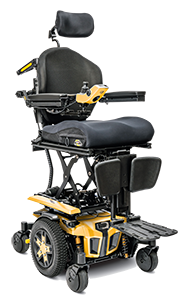
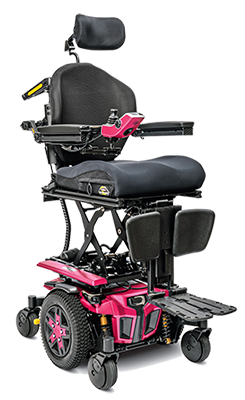
Quantum has pledged to contribute $50,000 to Team Gleason’s mission. Additionally, Quantum is funding life-enhancing seat elevation technology, such as its iLevel® system, for distribution by Team Gleason for those living with ALS.

“We are excited to work with Quantum to provide essential items on power chairs that will increase the independence of people living with ALS,” said Austin Edenfield, Technology and Care Coordinator, Team Gleason Foundation.

“Those living with ALS face daily challenges,” said John Storie, Vice President, Quantum Sales-Eastern America. “Access to life-sustaining mobility should not be one of them. “It’s our privilege to work with Team Gleason to ensure that those living with ALS have the best mobility technology and the highest quality of life possible.”

Team Gleason is accepting applications from those living with ALS interested in a power seat elevator. Please visit www.teamgleason.org/technologyfaq to fill out an application and to learn more about the assistive technology program at Team Gleason.


About Team Gleason
Team Gleason Foundation is a 501c3 nonprofit based in New Orleans, LA. Team Gleason was founded by former New Orleans Saints player, Steve Gleason, after his diagnosis with Amyotrophic Lateral Sclerosis (ALS) in 2011. Team Gleason aims to provide individuals with ALS with leading edge technology, equipment and services, to create a global conversation about ALS, and to raise public awareness towards ALS by providing and documenting extraordinary life adventures for individuals with muscular diseases or injuries. http://www.TeamGleason.org

Social Media:
Facebook: @TeamGleason.org
Twitter: @TeamGleason
Instagram: @TeamGleason

About Quantum Rehab

Quantum Rehab® is a premier global innovator of consumer-inspired complex rehab products, including the Edge 3, 4Front®, and Quantum Series of power bases, iLevel® seat elevation technology, TRU-Balance® 3 Power Positioning Systems, Q-Logic 3 Advanced Drive Controls, and Stealth Products® positioning components. Please visit www.QuantumRehab.com.

Dating in a Wheelchair 101

The dating world isn’t always easy. Dating with a disability adds another layer to the already complicated task of finding love. Whether you prefer to hit the bar scene or use online dating apps, questions about your disability will come up. Although now happily married, Quantum Consumer Advocate Stewart Lundy has some advice to share as a former single person who has a disability.

Stewart Lundy

I am not unfamiliar with the dating scene as I dated before I was married, while living in Miami. (Side note: I highly recommend going to Miami and hitting the social scene, at least one time while you’re single.) These are my dating do’s and don’ts if you have a disability:

  1. Be 100% real. If a person is into you, you’ll know it despite anything and everything you may say to them regarding your disability. Also, do you really want to date someone who is hung up on your wheelchair or power chair? If anything, that will tell you more about them.
     
  2. Tell your story one time, explain things when they need to be explained regarding your disability. However, this shouldn’t go on forever. You are getting to know one another, this is not an interview. I understand people are curious about people who are different, but at some point, it gets very annoying to you as the person who has a disability.
     
  3. Don’t go out on a date with someone who feels like you are their inspiration. They are not dating you, they are dating your journey.
     
  4. Remember this: no one is out of your league. If you see someone you are attracted to, confidence is your best friend. Even if you need to fake it. This goes for able-bodied people as well as people that may have disabilities. Confidence, confidence, confidence. I cannot stress that enough. Confidence is your friend, and it will make you a wheelchair boss.
     
  5. If you find someone attractive and they find you attractive, remember to be patient. This may be the first time they’re dating someone who has a disability. Make sure they’re into you. If they ask you questions, be sure to ask THEM questions. Keep it balanced.
     
  6. The more you can do for yourself, the better. If you’re comfortable with it, the person you are dating can do things for you, but you should always hold onto your independence. Not so tight that it pushes the person away, but be your own person.
     
  7. Don’t be afraid to be put in the friend zone. Some people see this as rejection, but I like to think of it as working behind enemy lines. When you are someone’s friend, they confide in you. If you’re in the right friend zone, this becomes an asset. Now this person looks to you for guidance. This is how people fall in love.

About Stewart Lundy: Stewart uses his 4Front® Power Chair with safe seat elevation to make a living through storytelling while also maintaining his personal sense of style.

WC19 Now Available on the Q6 Edge® HD with Synergy® Seating

A WC19 crash-test approved occupied transit option is now available on the Q6 Edge® HD Power Chair with Synergy® seating.

With standard features like 4-pole motors, Mid-Wheel® 6 Design, ATX Suspension, and optional iLevel® power adjustable seat height, the Q6 Edge HD is engineered to meet the performance needs of the most active user. Featuring a weight capacity of 450 pounds (400 pounds with iLevel), the Q6 Edge HD accepts a complete range of seating and electronics options to deliver exceptional rehab capability at an excellent value.

Edge 3: Now Available

The Edge 3 is now available! The design of the Edge 3 is for the most advanced power chair experience ever. Upgraded SRS (Smooth Ride Suspension) provides a smooth, comfortable ride and advanced stability. Optional iLevel® is available at 4.5 mph with up to 12” of power adjustable seat height. Standard features include front and rear LED fender lights, a USB charger, and drive wheel color accents. The Edge 3 is available in a total of 19 color options, including seven brand-new, bold colors. In addition, the Edge 3 is proudly made in America of foreign and domestic parts.

Features include:

  • Upgraded SRS (Smooth Ride Suspension)
  • Optional 4.5 mph with iLevel
  • Optional iLevel’s patented Extra Stability Technology enhances safety while performing transfers, reach, and numerous other activities of daily living
  • iLevel is retrofittable on the Edge 3
  • Fender lights, USB charger, and drive wheel color accents included
  • 7 bold new colors and a total of 19 color options
  • Made in America of foreign and domestic parts

Quantum Launches Edge 3 Advanced Power Chair with SRS Technology

Monday, June 4, 2018

DURYEA, PA – Quantum Rehab® is pleased to announce the launch of the Edge 3, the most advanced power chair ever.

The Edge 3 is the culmination of eight years of product improvement based on consumer, clinician, and provider input toward the award-winning Q6 Edge® series. It’s not a new power chair, but a better power chair, all based on market feedback.

Building upon the Edge 2, the Edge 3 features the added benefits of SRS technology (Smooth Ride Suspension), 4.5 MPH iLevel option, standard fender lights, standard USB device charger, and standard drive-wheel accents corresponding with new shroud color choices. All enhancements were specifically market-driven.

“Innovation always begins with listening,” shared Jay Brislin, Vice President of Quantum Rehab. “The latest advancements on the Edge 3 each come from what users, clinicians, and providers have wanted more of in this leading complex rehab power chair.”

Specifically, SRS technology evolved from consumers wishing a softer ride – from reducing spasticity triggers to easing use with specialty controls to an overall smoother ride. The industry-first 4.5 MPH driving speed while elevated with optional iLevel meets the need for greater speed while elevated, such as when crossing busy streets. And, the standard fender lights, USB port, and new colors are lifestyle features that increase the overall user experience. In all, the Edge 3 offers a true user-sought power chair experience.

“We’re proud that the Edge 3 is made here in America by our team,” adds Brislin. “This allows us the highest quality and shortest lead times in the industry on this totally custom-built unit.”

 For more information on the Edge 3, please click here for a video overview and visit QuantumRehab.com.

About Quantum® Rehab

Quantum Rehab® is a premier global innovator of consumer-inspired complex rehab products, including the Edge 3, 4Front®, and Quantum Series of power bases, iLevel® seat elevation technology, TRU-Balance® 3 Power Positioning Systems, Q-Logic 3 Advanced Drive Controls, and Stealth Products® positioning components. Please visit www.QuantumRehab.com.

Flight Risk: Flying with a Power Chair

From vacations to business trips, people with disabilities travel every day, all over the world. The U.S. Department of Transportation enforces the Air Carrier Access Act (ACAA), a law that makes it illegal for airlines to discriminate against a passenger with a disability. The ACAA applies to all flights traveling to, from or within the United States. (https://www.transportation.gov/airconsumer/passengers-disabilities)

Even with protection of the ACAA, news outlets often report conflicts between passengers with disabilities and airlines. Quantum brand ambassadors Jesse Cuellar and Josh McDermott have done a lot of traveling, and have experienced both good and bad circumstances while flying with their power chairs.

Jesse Cuellar

Generally, I’ve had some good experiences while traveling to places like California or Tennessee. Airlines are fast and efficient in getting my power chair to me after I land, and my chair isn’t messed up when they bring it to me. Still, there needs to be a class or training for airlines, so employees can understand how to maneuver most power wheelchairs. Every situation is different, but half the time the airline staff doesn’t know what they’re doing. Power chairs are becoming more of a staple in the community and people need to learn more about them.

Josh McDermott

I fly frequently with my chair. In 2017, I flew from Newark to Nashville for an industry tradeshow. The ground crew in Newark had difficulties getting my chair onto the plane, causing the flight to be delayed. When I arrived in Nashville, I found out my power chair had been damaged. The swing-away joystick mount was bent, and the joystick’s screen was totally smashed. The disability service team apologized for the damage on my chair, yet, it wasn’t their fault. Whoever loaded or unloaded my power chair onto the plane clearly didn’t know what they were doing. 

It’s important for airline employees to understand that these products are high-end rehab wheelchairs. We just about live in these chairs and they are custom fit to our needs. We can’t just go down to the local store after we land at our destination and buy a replacement chair. Airports and airlines need to be held accountable and they need to offer better education for their employees who handle our wheelchairs.

Know Your Rights

While flying, an assistive device may be stowed in the following locations:

  • An overhead compartment
  • Under the seat in front of you
  • In a designated stowage area if the device fits and is in accordance with FAA or foreign safety regulations

If the device cannot be stowed in the passenger cabin, it can be stowed as cargo at no extra cost. After your flight, your device must be returned to you in a timely manner and brought as close to the door of the aircraft as possible, unless you request to pick it up in baggage claim. Furthermore, airlines must check and return your assistive device to you in the same condition as it was received.

(https://www.transportation.gov/individuals/aviation-consumer-protection/wheelchairs-and-other-assistive-devices).

Kozmo™, Kozmo™ Portable Now Available

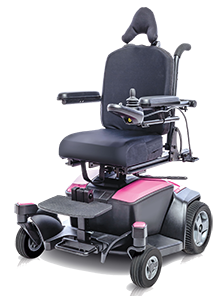
The Quantum® Kozmo™ and Kozmo™ Portable pediatric power wheelchairs are now available!

The all new Kozmo and Kozmo Portable are engineered to meet the needs of even the most active child. Their highly compact size provides easy access to kid-sized spaces, while kid-friendly color choices add a fun, personal touch.

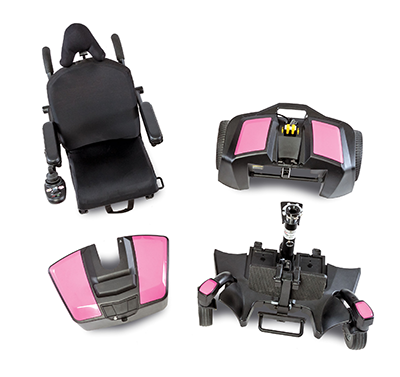
The Kozmo Portable provides one-hand, feather-touch disassembly makes transport fast and convenient for parents on the go.

Whether on the playground or in the home, your child will have a blast with the Kozmo or Kozmo Portable.